
SERVICES
UX/UI Product design
Responsive web
Design systems
UX research
Design-to-dev handoff
Team leadership
Information architecture
PRODUCT
Go.Pidge
ROLE
Product design lead
TIMELINE
Concept to MVP, under 10 weeks
The meeting problem.
Investors meet founders everywhere: conferences, demo days, networking events, a chance introduction at a dinner. In those first minutes, one question matters more than any other. Is this person worth my time? The information to answer it exists somewhere, in a deck, a data room, a dozen browser tabs, but never where it's needed: in your hand, verified, right now. So investors leaned on gut feel in the moment, and slow, fragmented due diligence later, often days after the conversation had already gone cold.

We asked the people who do this for a living.
Every major decision traces back to interviews with founders and with investors at NatWest, Citi, J.P. Morgan and Prosper. Three findings shaped the product more than any other.
[ finding 01 ]
Credibility is the first question
Before anything else, investors wanted to know whether a founder's claims held up → shaped the Trust tab.
[ finding 02 ]
The decisive moment is in person
The highest-intent moment was the meeting itself, phone in hand, not a desktop review days later → shaped the scan-to-open, mobile-first architecture.
[ finding 03 ]
Founders guard their information
They wanted to share enough to be taken seriously, without handing everything to everyone → shaped the permission controls.
A profile you could open by shaking hands.
Scan, and you're in.
The whole product turns on a single gesture. An investor scans a founder's QR code and gets instant, secure access to their Passport. No app-store friction for a first look, no emailing a deck later, no losing the moment. It had to work standing up, in seconds, in a noisy room. That is why the entire product is mobile-first. Not a platform choice, the scenario made physical.

Navigation as product architecture.
The data behind a founder is genuinely complex: financials, trust signals, business model, media, investor notes. All of it had to live on a phone without overwhelming anyone mid-conversation. The solution was a flat five-tab structure. One tab, one job. This was an information architecture decision, not a UI one, and it shaped the product from first wireframe to final handover.
About
who they are
Trust
can I believe them?
Business
how it works
Notes
user notes on the connection
Media
see it in action


Trust, as its own destination.
Because credibility was the investor's first question, it got equal billing with the business itself. The Trust tab turned slow background-checking into an at-a-glance read: a Trust Velocity Index and Credibility Compound Rate that let an investor gauge, in the moment, whether the claims in front of them were worth pursuing.
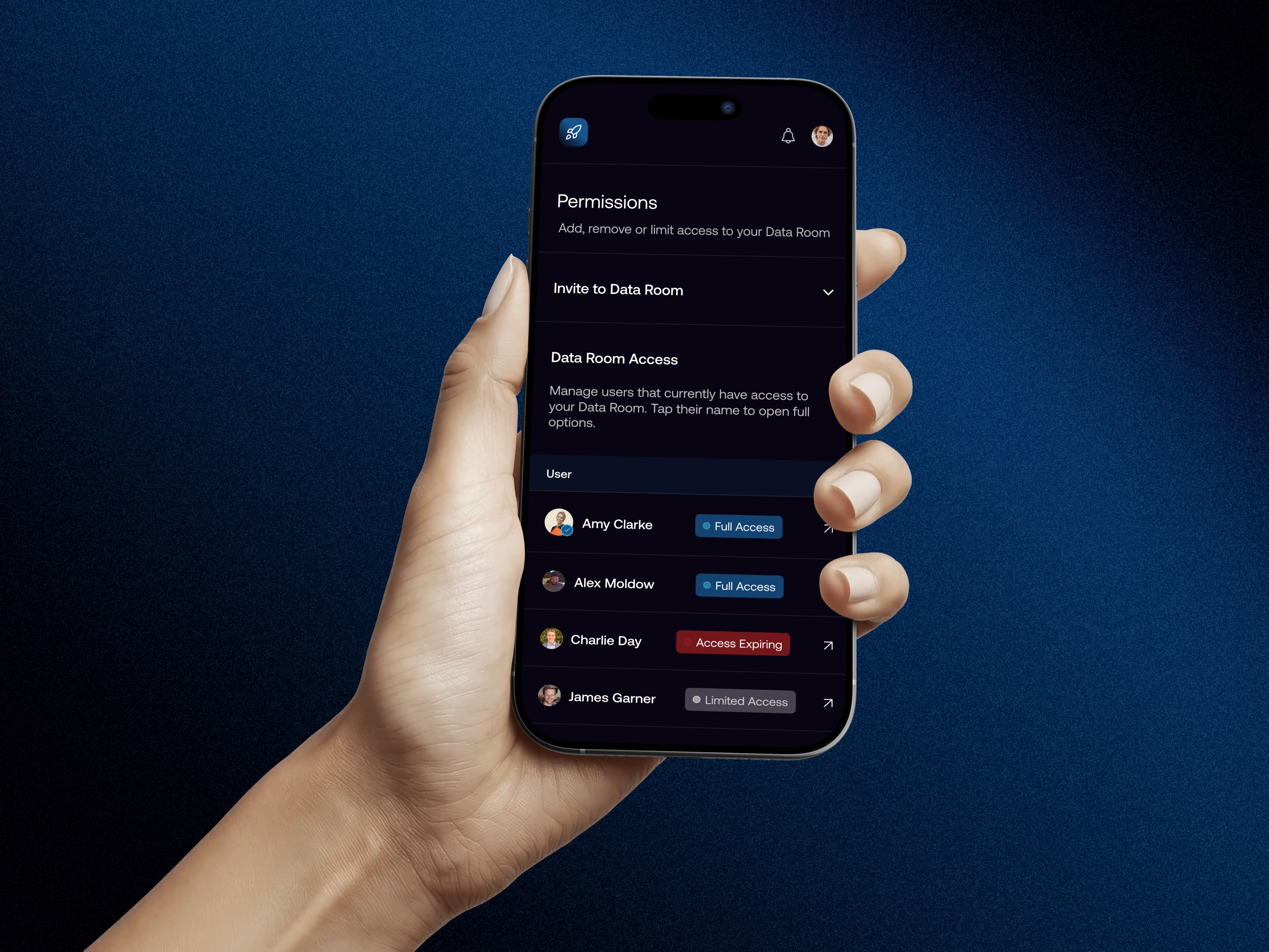
The founder holds the keys.
A founder decides what each investor can see, profile and data room alike. Share the headline story with a new contact, open the full data room to a serious one. Putting founders in control of their own disclosure is what made them willing to put real information in at all.
Built to be shared.
Investors rarely decide alone. A Passport could be passed to the wider team, so the people who weren't in the room still had everything they needed in one place, instead of a forwarded deck and a half-remembered summary.
THE HARD PART
Density was the enemy.
The whole product lived or died on one tension. An investor needed enough to make a real judgement, financials, trust signals, business model, the data room, but they were reading it standing up, mid-conversation, in a noisy room, on a phone. Show too little and it's a business card. Show too much and it's the exact overwhelming mess the Passport was meant to replace.
The answer was to treat the tab order as the content hierarchy, mapped to the questions an investor actually asks, in the order they ask them. The first tap opens on About: a quick read on the person or company they've just met, because that's the first thing anyone wants to confirm. Trust comes second, because credibility is the next question the moment the introduction is over. The deeper business detail follows from there. Nothing is buried, but nothing arrives before it's needed. Each screen leads with the one thing that matters most for that step and keeps the rest one tap away, there if you want it, invisible if you don't.

Shipped, and the numbers came back.
The Startup Passport launched as a live PWA with real users on both sides. The early results were strong.
The MVP proved the model. It was a starting point.
The next iteration would have deepened the investor side, richer comparison across Passports, and instrumented the profile-completion flow to find where founders dropped off. The biggest open question was trust at scale: keeping verification signals meaningful rather than noise as more companies joined. Designing for that was the problem I was most looking forward to.


